Published
- 5 min read
Higher, faster
The Singularity is Near-ish
Much to Albert Bartlett’s dismay, I underestimated the exponential function. I’m still not sure if the latest models understand anything, but they are folding proteins in seconds that would have taken human researchers decades. The code they are writing is at times more performant, more secure, and more elegant than I can produce.
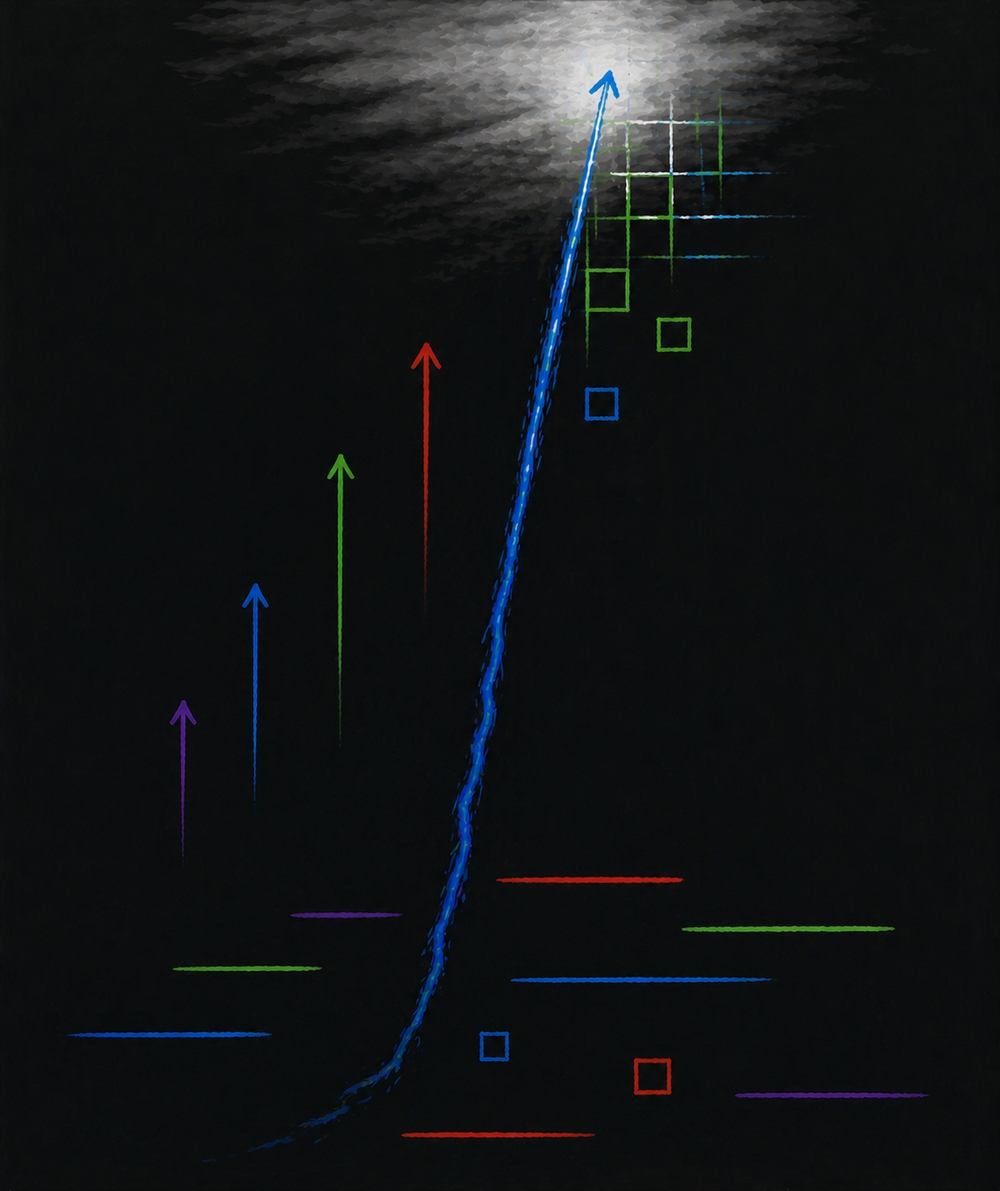
The rate of change is not linear, nor is it exponential in a way I can intuitively grasp. I am standing at the base of a cliff, looking up at a vertical line, and the top is obscured by clouds.
The Vertical Line
I remember reading Kurzweil years ago and thinking he was an optimist. I perceived the Singularity as a metaphor, a horizon line we would approach asymptomatically but never quite reach. I have begun to reconsider. Every week, a new paper drops that renders the previous month’s state-of-the-art obsolete. We are used to technology moving fast, but this is different. Beyond Moore’s Law, where chips get twice as fast every 18 months, we are building the tools that build the tools that build the minds that will outthink us. I keep expecting to hit a wall of diminishing returns - “data scarcity,” “compute limits,” “thermodynamic bottlenecks” - but every time I think we’ve stalled, a new architecture or training method emerges and the line goes vertical again. The researchers and scientists, fueled by the billions of dollars saved up waiting for this exact moment, never seem to rest.
The Obsolescence of Skill
And I have never doubted my future as much. I used to measure my professional value in years of experience. “It will take me 2 years to master this framework.” Now, by the time I master a framework, an AI can generate the entire codebase instantly, and the framework itself is likely obsolete, replaced by an AI-native abstraction layer I haven’t even heard of yet.
So what is the value of human learning in this new world? The execution constraint is gone. For all of human history, the gap between “idea” and “reality” was bridged by labor, skill, and time. Building a bridge required engineers, architects, construction workers, and years of effort. Today, if I can imagine it, the AI can help me build it. The bottleneck is no longer skill; it is no longer the ability to grind leetcode or debug race conditions.
From “How” to “What”
When building was hard, we self-regulated. Only the ideas that were truly necessary, or profitable, or deeply passionate made it through the pain of execution. Now, that friction is near zero, and we are flooded with noise. This brings me to my core realization: My value as a human is no longer about “how to do” things. It is about “what to do.” In a world of infinite generated content, the ability to discern signal from noise is ever more important. It is the ability to look at ten thousand AI-generated variations and say, “That one. That is the one that matters.”
This, ironically, is a much heavier burden than mere execution.
When my job is to center a div, I know when I’m done. The div is centered. The ticket is moved `to “QA.” There is a satisfaction in the closed loop of defined tasks. But when my job is to decide what to build? That is an open loop that requires me to think about things beyond my favorite realm of pure code.
If I can build anything, I am responsible for everything I build in a way I wasn’t before. “I was just following specs” is no longer a valid excuse when I essentially wrote the specs by prompting the model. We are all becoming Product Managers of our own lives, directing a team of infinite AI interns. And as I’m led to believe by every manager I’ve ever known, that is not exactly a vacation. It requires clarity of thought, an ability to effectively communicate, and a distinct, single-minded focus on the outcome.
Identity Crisis
“When a customer comes in asking for a shovel, they are not looking for a shovel. They are looking for a hole.” This is a quote from my business teacher, a role I find fitting as we move toward a world where everyone is a Product Manager. It feels like theft, that a child with a prompt can replicate 80% of my human-written code in minutes. But I realize that’s irrelevant, and a mistake in perspective. My purpose was never to write C++ syntax, but to solve problems and help people. C++ was just the shovel I used to dig the hole. Now I have an excavator. The shovel is useless, but the hole still needs digging.
The Best Kind of Human
So who falls on top in this acceleration? I think it’s the generalists. The people with deep, eclectic interests who can connect dots across disciplines. AI knows everything about everything in isolation, and our role is to provide context. We are becoming the conductors of an orchestra we didn’t compose, playing instruments we can’t physically hold. Our job is to listen, to guide, to wave the baton, and to ensure that the cacophony resolves into a symphony.
A Different River, A Different Man
I wake up some days feeling obsolete, wondering if I should just go learn to farm (though I’m sure autonomous tractors will beat me there too). But I can’t help but feel fortunate to live at this very moment. As Justin Trudeau said (back in 2018 before all of this started (and before covid omg)), “The pace of change has never been this fast, yet it will never be this slow again.” We are living through the most significant transition in the history of our species.
Don’t look down.